Sound as information
Each cue has a defined purpose and carries interpretable information: position, distance, direction, state or context.

VCS · Vis Caeca Soni · More than 20 years of evolution
VCS —Vis Caeca Soni, “the hidden power of sound”— is a spatial interaction framework that represents, explores and operates in three-dimensional environments through structured sound.
It does not simply add audio to a finished visual experience. It starts from a different premise: when sound must communicate position, distance, orientation or state, the environment must be designed from the outset so that this information is clear, consistent and usable.

Vis Caeca Soni
VCS grew out of research into how a blind or visually impaired person can build a reliable mental model of a three-dimensional space without depending on imagery. Over time, that work evolved into a broader sound-based spatial interaction system.
Sound stops being ambience and becomes a channel for perception, information and interaction. Users can request information, explore the environment and make decisions from sound cues designed to retain a stable meaning.
Each cue has a defined purpose and carries interpretable information: position, distance, direction, state or context.
The user is not fed a continuous narration. Exploration and navigation tools can query the space on demand.
Signals are prioritised to prevent saturation. Safety and navigation take precedence over secondary or ambient information.
VCS 2026
Auditory localisation combines timing and intensity differences between the ears, spectral modifications, reflections and reverberation. Yet perception differs between people and is not completely stable over time.
VCS therefore includes auditory calibration. It is not intended as a clinical diagnosis: it creates a functional profile that adapts spatialisation and system tools to the user’s actual perception at that moment.
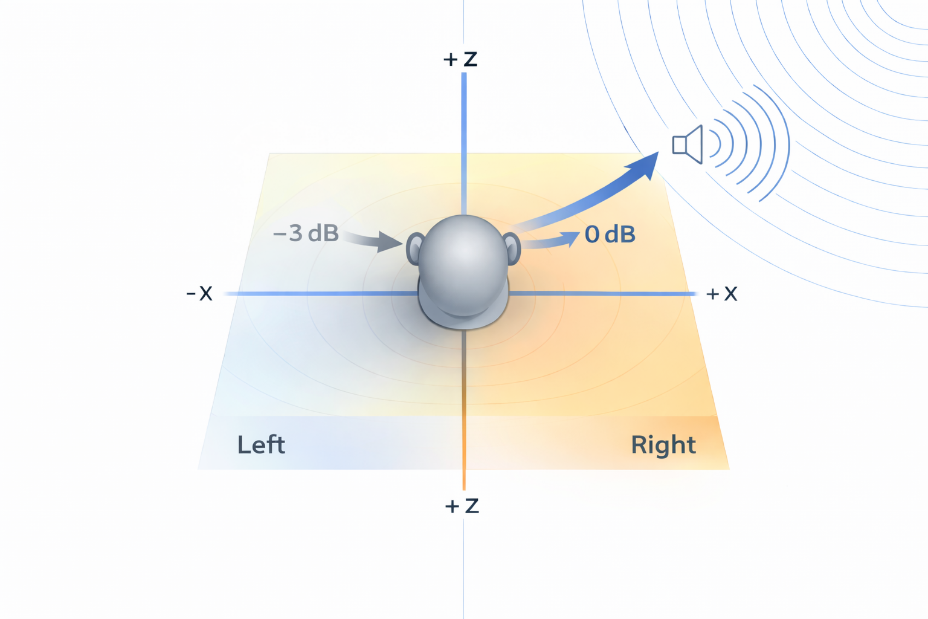
Adjusts the perceived centre between both ears. Defines minimum and comfortable listening levels. Avoids relying on frequencies outside the user’s effective range.
VCS represents the environment as a collection of objects carrying spatial, perceptual, behavioural and state information. Position is an attribute of an object, not the sole foundation of the system.
This model is used by an environment engine, the user’s auditory profile, the VCS interaction engine and a sound manager that determines which cues are played, in which order and at what priority.
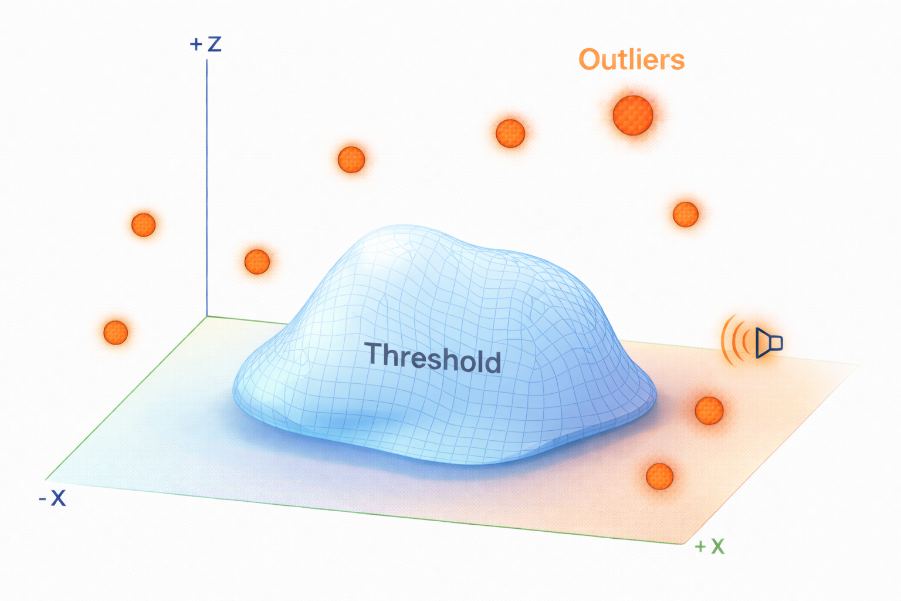
Adjusts how much directional and positional detail the user can discriminate. Calibrates how changes in proximity are encoded.
VCS Toolset
VCS tools share the same data model, auditory profile and priority rules. They are not isolated effects: they work together as parts of a common architecture.
Movement and direction references that help maintain a stable relationship with the space.
Provides a global orientation reference.
Support frontal exploration or a global understanding of objects surrounding the user.
Detects multiple relevant elements in the environment at the same time.
Structures navigation through nodes and relationships between points in the environment.
Provides continuous directional guidance when the situation calls for it.
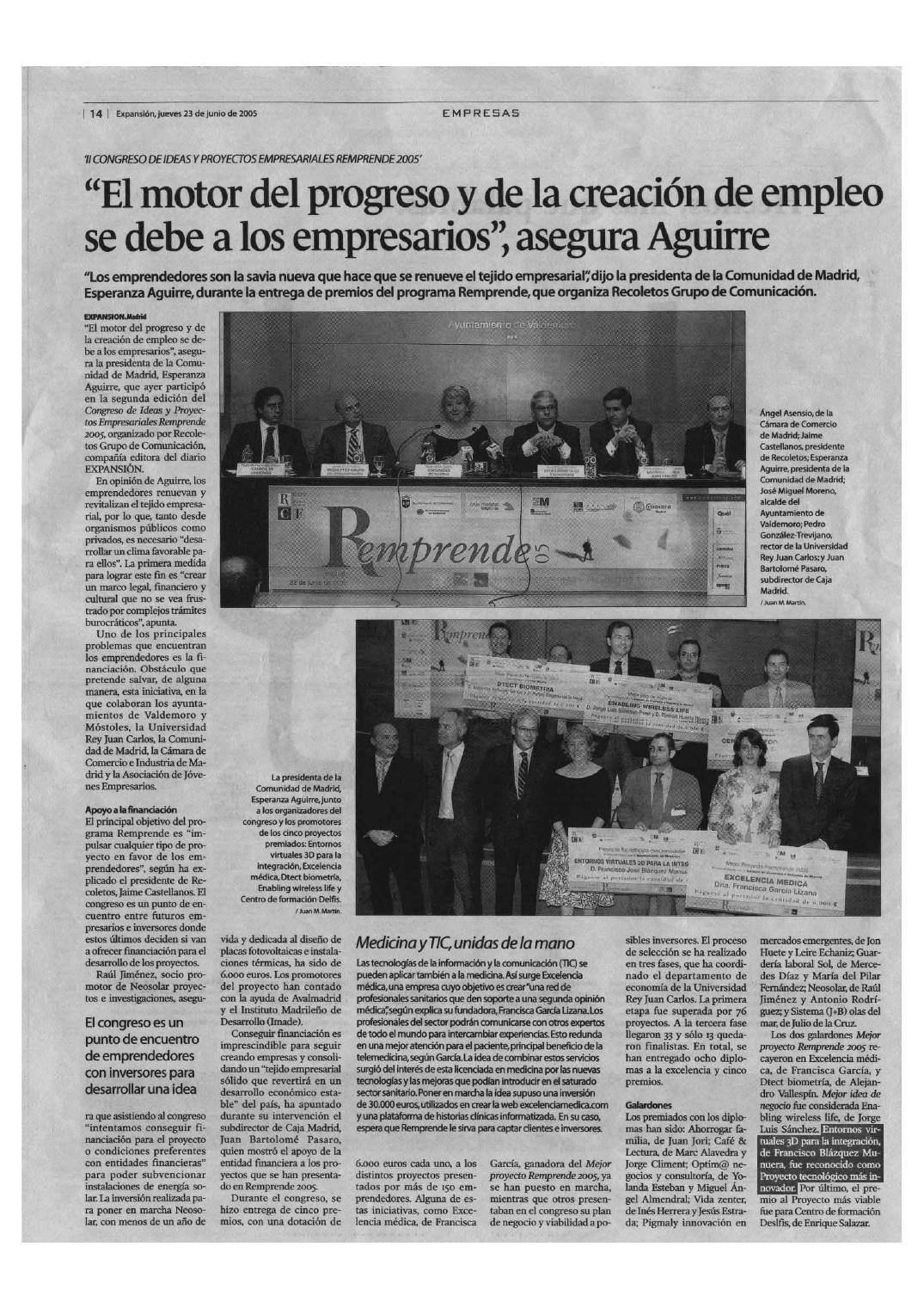
Expansión · 23 June 2005 · Business section · REMPRENDE 2005.
REMPRENDE 2005
The project “Entornos virtuales 3D para la integración”, by Francisco Blázquez Munuera, was recognised as the Most Innovative Technology Project at the II Congreso de Ideas y Proyectos Empresariales REMPRENDE 2005.
Page 14 of Expansión, dated 23 June 2005, records the award and provides a public documentary origin for the research line that would later evolve into VCS. The report describes a process involving more than 150 entrepreneurs and participation by the Economics Department of Universidad Rey Juan Carlos.
ONCE-CIDAT
Onae, Zoe’s Adventure turned those principles into a complete 3D experience. The objective was for sighted and blind players to share an adventure under comparable conditions, using sound space as a genuine part of the gameplay.
Later ONCE-CIDAT documentation on videogame accessibility good practices used Onae as a practical reference when discussing three-dimensional accessibility and navigation without visual dependence.
View Onae, Zoe’s AdventureVCS 6.0
Totana 1578 uses a new generation of VCS adapted to an isometric investigation adventure. The system is not limited to “making a visual game accessible”: it forms part of the design for orientation, exploration, interpretation of the environment and mission flow.
View Totana 1578Public recognition of “Entornos virtuales 3D para la integración”.
Commercial application of VCS to an accessible 3D adventure developed for ONCE-CIDAT.
Publication and documentation of early versions of the system.
Aurlink is created as an independent technology focused on augmented reality, positioning, connectivity and mobile devices. Years later, its combination with VCS would be explored for specific scenarios.
Exploration of VCS for real-space maps and its combination with mobile and augmented-reality technologies.
New architecture, calibration, object model and evolved tools applied to new projects such as Totana 1578.
VCS and Aurlink are separate technologies. VCS focuses on spatial interaction and representing an environment through sound. Aurlink, developed later, brings together methods and components for augmented reality, positioning and mobile devices.
In some projects the two technologies can complement each other. A VCS representation of a real space, for example, can be combined with physical or mobile references handled through Aurlink. That relationship does not make either technology a component of the other.
VCS is one of the most valuable technology assets now converging within Crannsoft. Its history spans research, videogames, accessibility and experimentation with real spaces.
But VCS does not define or limit everything Crannsoft produces. Some games and projects use it because it provides a distinctive way to understand and interact with space; others use entirely different architectures and objectives.